
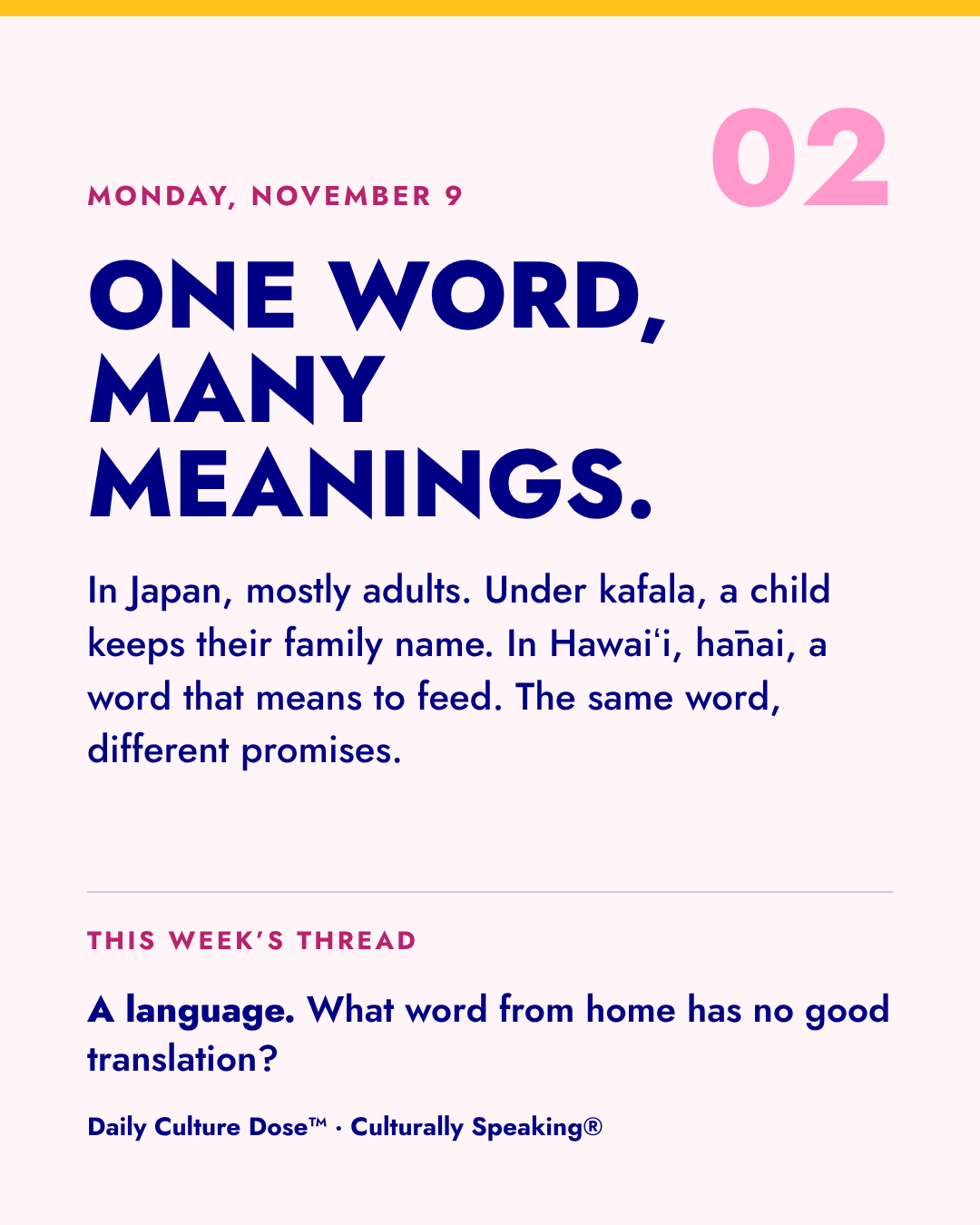
In Japan, mostly adults. Under kafala, a child keeps their family name. In Hawaiʻi, a word that means to feed.
Last week I wrote about Korea, where some 200,000 children were sent overseas for adoption and where the country is now reckoning with how it happened. This week, four places where the same word holds very different promises.
Japan: adoption as succession
In fiscal year 2025, Japan registered 85,052 adoptions. Special adoption, the court-approved kind that fully places a young child into a new family, is a small share of that: 693 cases in 2020, short of the government’s goal of 1,000 a year by 2022. Most adoptions in Japan are ordinary adoptions, which have no age limit for the person adopted, and many adoptees are adult men taken in as heirs to carry a family name or business forward.
Kafala: guardianship that keeps a child’s name
Islamic law keeps a child’s lineage intact. Under kafala, a guardian raises, protects, and provides for a child, and the child keeps their family name, identity, and inheritance rights. International law increasingly recognizes kafala as its own form of care, distinct from both adoption and foster care.
Hawaiʻi: a word that means to feed
In the Hawaiian dictionary of Mary Kawena Pukui and Samuel H. Elbert, hānai means a foster or adopted child, and also to raise, feed, nourish, and sustain. Through the binding hānai promise, a child was given to another family and became fully part of it. Hawaiʻi’s last queen, Liliʻuokalani, was given at birth as a hānai child to High Chief Abner Pākī and High Chiefess Laura Kōnia, and later raised hānai children of her own. In her own words, the custom “seems perfectly natural to us.”
The United States: adoption from foster care
Most adoptions in the United States now happen at home. In fiscal year 2023, 50,193 children were adopted from foster care, the lowest number in two decades. On National Adoption Day, Saturday, November 21 this year, courts in more than 400 communities finalize and celebrate adoptions from foster care.
One word, many ways to belong
Put side by side, these cultures are asking the same question in different ways: what does a child keep, and what do they receive? A name. A lineage. A language. A table to eat at. Every one of those is a thread.
Each answer is a choice a culture made about belonging, and most of us inherited those choices.
This week’s thread
A language. What word from home has no good translation?
Walk your answer through the four phases of Adopting Threads™, and add your thread to the Community Tapestry.
Next Monday: we are all adopted into something.
Culturally Speaking,
Mia
Sources
Japan, 85,052 adoptions registered in fiscal year 2025: Ministry of Justice, Family Register Statistics (data table via e-Stat)
Japan, special adoptions (693 in 2020; goal of 1,000 a year by 2022) and adult heirs: The Japan Times, December 25, 2021
Hānai definition: Pukui and Elbert, Hawaiian Dictionary (1986), via Wehewehe Wikiwiki, University of Hawaiʻi
The hānai promise; Liliʻuokalani, Pākī, and Kōnia: Kamehameha Schools
Liliʻuokalani, “seems perfectly natural to us” (from Hawaii’s Story by Hawaii’s Queen): Maui Magazine, December 24, 2016
50,193 adoptions from US foster care in FY2023: National Council For Adoption, May 13, 2025
National Adoption Day, November 21, 2026: nationaladoptionday.org