
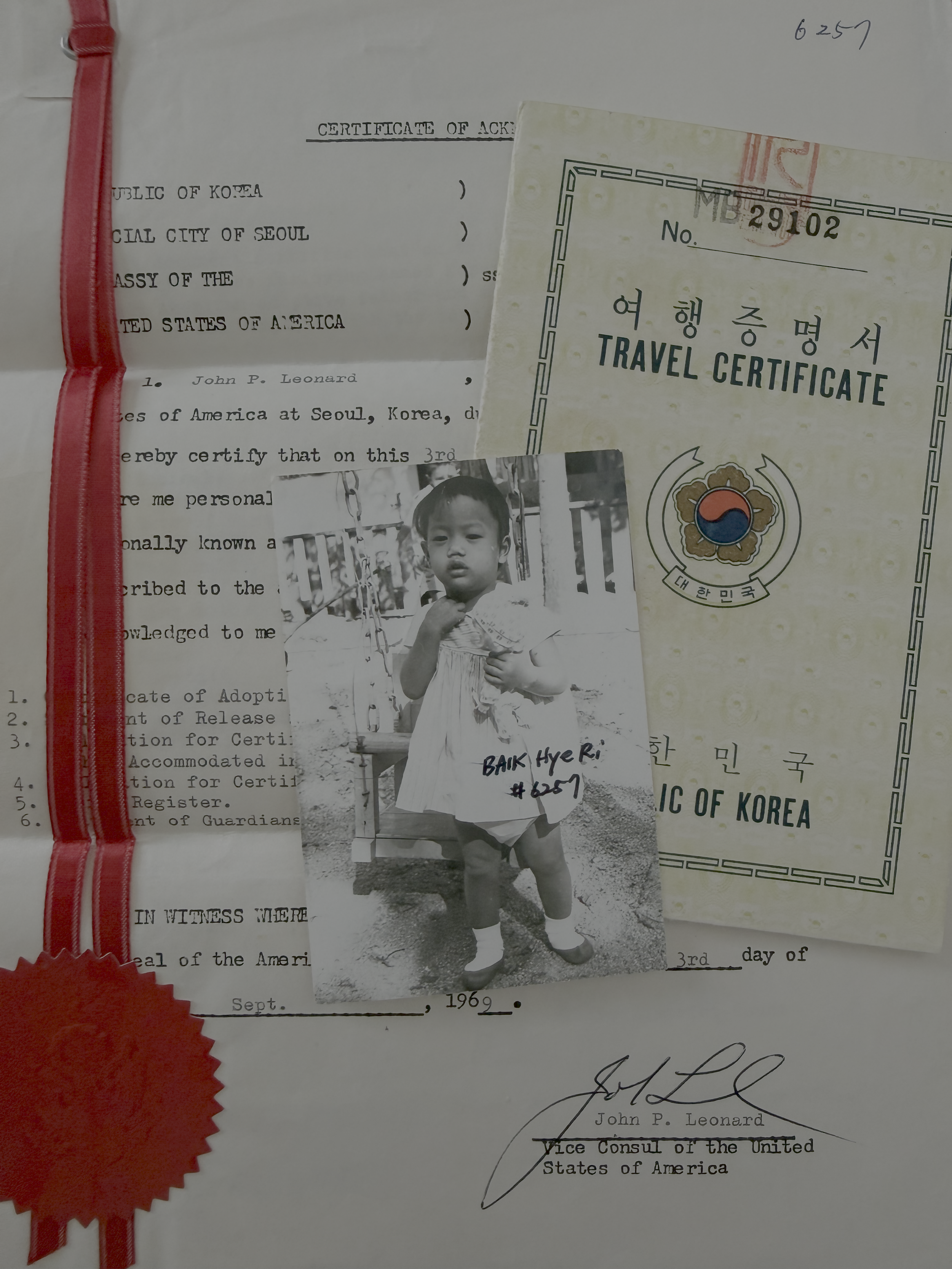
My adoption papers, 1969.
For National Adoption Month, a four-part series begins in Korea, and with how adoption across borders is changing.
I was a post-war orphan, left at one week old in a train station outside of Seoul. I was one of some 200,000 Korean children sent to families overseas over seven decades. So when November arrives and the United States marks National Adoption Month, I think about how one word, adoption, carries a different meaning in almost every culture.
For the next four Mondays, the Daily Culture Dose™ looks at adoption around the world, and at the wider ways each of us is adopted into something. This week begins where my own story begins: Korea, and the changing map of adoption across borders.
Korea: a country reckoning with its history
In March 2025, South Korea’s Truth and Reconciliation Commission found that the government bore responsibility for human rights violations in overseas adoptions, after 367 adoptees asked it to investigate. Agencies had recorded children with known parents as abandoned orphans and, at times, switched children’s identities. On July 19, 2025, Korea moved every adoption from private agencies to a public system run by national and local government.
For adoptees like me, these are records of our own beginnings. A name, a birth date, and a place of origin are the first threads anyone receives. When they are written down wrongly, a person may spend years untangling them.
The world is adopting across borders far less
Intercountry adoption peaked twenty years ago. In 2004, families in the United States adopted 22,988 children from other countries. By fiscal year 2023, that number was 1,275, a drop of 94 percent. France went from 4,079 international adoptions in 2004 to 103 in 2024.
Countries that once sent the most children abroad are closing the door. Guatemala stopped in 2008. Ethiopia followed in 2018. China ended foreign adoption in 2024, except for stepchildren and close relatives. On the receiving side, Denmark’s only international adoption agency closed in early 2024, and the Netherlands plans to phase out adoption from other countries by 2030.
Behind each number is a person who grew up between at least two cultures: the one they were born into and the one they were raised in.
Adopted into something
Before any of us can choose, someone chooses for us: a name, a language, a family, a country. For adoptees, those choices are written into records. For everyone, they are written into daily life.
This is the idea behind Adopting Threads™. Every human being is adopted into something: a family, a place, a culture. Some of us live that explicitly. Everyone lives it in some way. The work is choosing which threads to carry forward, in our own words.
This week’s thread
A name. Who chose your name, and what were they hoping for?
Walk your answer through the four phases of Adopting Threads™, and add your thread to the Community Tapestry. Each thread fills one square of a shared artwork of 3,000 threads.
Next Monday: one word, many meanings, from Japan to Hawaiʻi.
Culturally Speaking,
Mia
Sources
About 200,000 Korean children adopted overseas; Truth and Reconciliation Commission findings, 367 petitions: AP, March 26, 2025 and American Society of International Law
Korea’s public adoption system from July 19, 2025: UCA News
US international adoptions 22,988 (2004) and 1,275 (FY2023); France 4,079 to 103; Guatemala, Ethiopia, China, Denmark, Netherlands: Pew Research Center, July 25, 2025
China’s exception for stepchildren and relatives: Holt International