
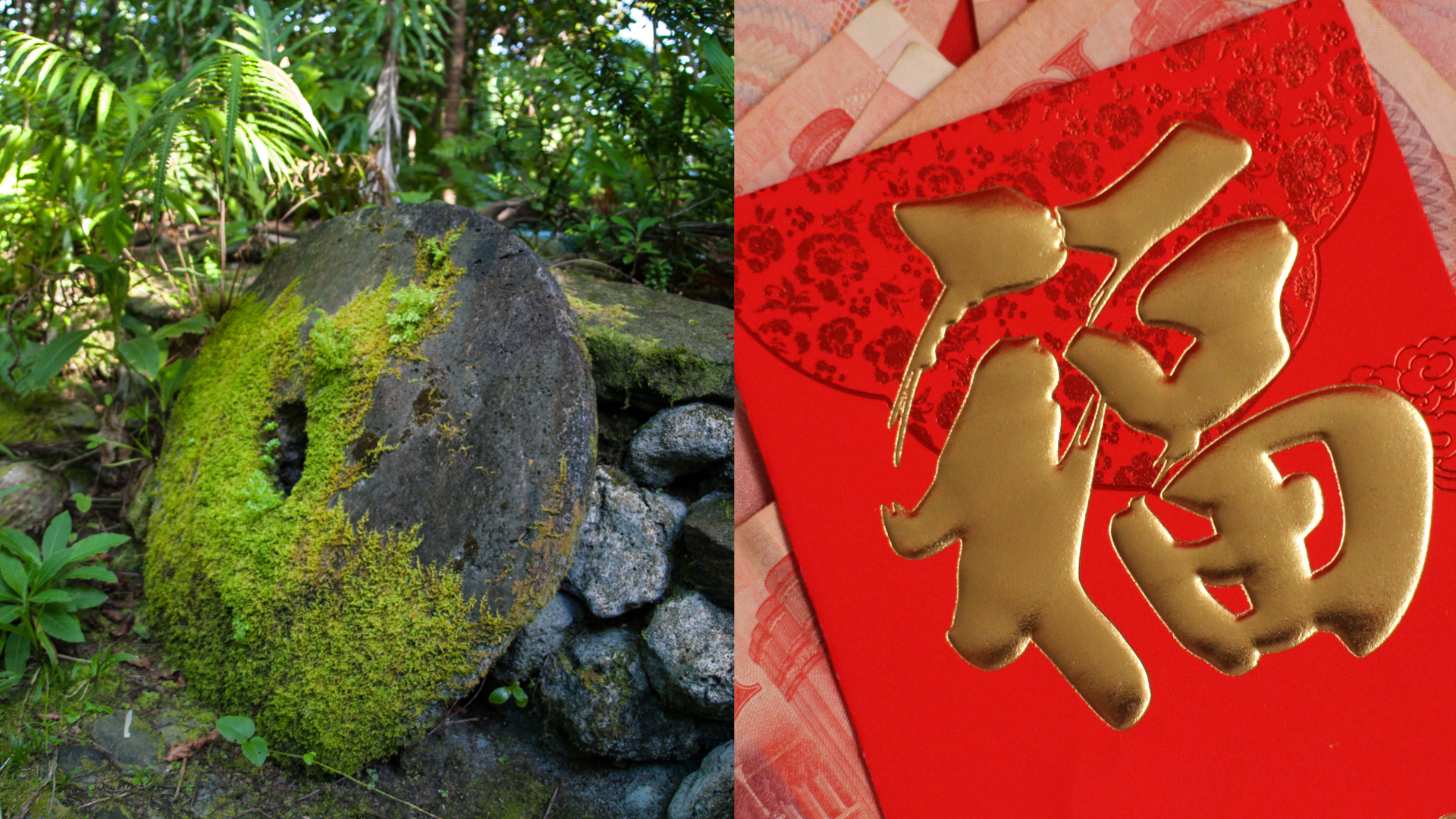
From stone money in the Pacific to red envelopes on a phone, every culture trades in more than coins.
Hand someone money and two exchanges happen at once.
One is easy to count.
The amount. The bills. The balance.
The other carries no number at all.
Whether the bills are crisp or folded.
Which hand offers them.
Whether you count them in front of the person.
What the envelope looks like.
Whether you should have offered at all.
The market sets the price.
Culture sets the meaning.
And it has been doing so for as long as people have traded.
A currency held in shared memory
On the islands of Yap, in the western Pacific, people once traded in rai: stone discs carved from limestone quarried on the islands of Palau and carried home by canoe. Most measure 30 to 50 centimeters across. The largest still standing is 3.6 meters wide and weighs about 4,000 kilograms.
Stones that size rarely moved. So when one changed hands, it stayed exactly where it was. The community simply agreed it now belonged to someone else, and that agreement became part of the stone’s story.
One account makes the point beautifully. A stone fell from a canoe during the journey and sank to the bottom of the sea. Nobody ever saw it again. Everyone agreed it was still there, so it continued to be traded.
In 1991 the economist Milton Friedman compared Yap’s stones to the gold vault of the Federal Reserve Bank of New York, where gold can change owners without ever leaving the room.
Yap uses modern money for everyday purchases today. Rai still changes hands in traditional ways, for moments such as marriage and inheritance.
From a Culturally Speaking® perspective, that is the heart of a cultural currency:
Value lives in agreement.
Agreement lives in people.
People carry it in their culture.
The same gift, three sets of instructions
Money given by hand rarely travels alone. It arrives with a ritual.
In Korea, on Seollal, the Lunar New Year, children bow deeply to their elders in a greeting called sebae. The elders answer with words of blessing and an envelope of New Year money, sebaetdon. The child counts the money. Everyone else is watching the bow, the blessing, and the order of the bows.
In Japan, a wedding gift of money, shūgi, follows careful rules. Many people use brand-new bills, which carry the idea of something fresh and untouched. Amounts often begin with an odd number, since an even number divides easily and may suggest a couple splitting apart.
At a funeral, money given as kōden follows the opposite rule. New bills could imply the death was expected and prepared for, so some people fold a crisp bill before giving it.
Same country. Same currency. Opposite instructions.
In China, red envelopes, hongbao, carry money and good wishes at Lunar New Year. In January 2014, WeChat launched digital red envelopes, and the ritual moved onto phones. Over the 2018 holiday, Tencent reported that 768 million people used them.
The envelope changed form.
The custom traveled with it.
Often, the money is the least interesting part of the gift.
Whose story does the money tell?
Currency also carries identity. Many national banknotes feature a country’s own leaders, artists, and landmarks. So when Europe’s countries came to share one currency, the euro faced a cultural question: whose face, and whose building?
The answer was windows and doorways on the front of each note and bridges on the back, drawn in styles from across Europe’s history, from classical to the iron and glass of the nineteenth century. According to the European Central Bank, the notes “do not show any actual existing monuments or bridges.” It describes the windows and doorways as symbols of openness and cooperation, and the bridges as symbols of communication between the people of Europe and the rest of the world.
Shared money needed a shared story, so the designers drew places that exist nowhere in particular and feel like everyone’s.
And now money is moving into our phones
For most of history, cultural currency had something to hold. The envelope. The bill. The coin pressed into a palm. The stone at the edge of the village.
That is changing quickly. In the euro area, cash was used for 52% of payments at the point of sale in 2024, down from 59% in 2022, according to the European Central Bank. Yet 62% of people said having the option to pay in cash remains important to them.
Read those two numbers together. People are using cash less, and most still want it kept. Something beyond convenience is being held on to.
Tipping in the United States shows the same tension from another side. In a 2023 Pew Research Center survey, 72% of adults said tipping is expected in more places than it was five years ago. Only about a third found it extremely or very easy to know whether to tip (34%) or how much (33%).
A screen turns toward you with three suggested percentages, and a custom is rewritten at the counter.
When money becomes a tap, who teaches us what it means?
A student arriving in Tokyo, a new hire joining a team in New York, or an adult child caring for a parent in Seoul may each need to know:
Is offering to pay a kindness or an insult?
Is splitting the bill fair or cold?
How much is generous, and how much is too much?
Should cash come in an envelope, and which one?
Is salary something to discuss openly or keep private?
Who pays when three generations share a meal?
Is a gift opened in front of the giver or later?
When does a tip say thank you, and when does it say something else?
These are not simply money questions.
They are cultural navigation questions.
What passes between generations
In the United States alone, Cerulli Associates projects that $124 trillion in wealth will change hands through 2048. Each of those transfers moves a number from one account to another.
Each family also passes along a second inheritance: how it talks about money, what it saves for, what it gives, and what it expects in return.
Two heirs may receive the same amount and inherit entirely different currencies.
Every culture keeps two ledgers
A stone resting on Yap. Crisp bills in a Tokyo wedding envelope. A bow before a grandparent in Seoul. A red envelope sent across a phone. A tipping screen at a coffee counter.
Their forms differ.
Their rules differ.
Their histories differ.
Yet each one keeps two ledgers. The first records the amount. The second records the relationship: respect, gratitude, obligation, celebration, and trust.
Economics tracks the first ledger with great precision. The second is where people quietly decide whether they are welcome.
We have become extraordinarily good at asking:
How will technology change the way we pay?
We should also be asking:
What will our money still carry when there is nothing left to hold?
CULTURE, HIDING IN PLAIN SIGHT.
Every payment settles a price.
Every gift writes a relationship.
The amount travels in numbers.
The meaning travels in culture.
Take your Daily Culture Dose™.
This week’s thread
A way of handling money. What were you taught about giving to others?
Walk your answer through the four phases of Adopting Threads™, and add your thread to the Community Tapestry.
Cultural Currencies is a Daily Culture Dose™ series by Culturally Speaking®. This is our last Daily Culture Dose™ for October. In November, for National Adoption Month, we look at adoption around the world, with a new post each Monday.